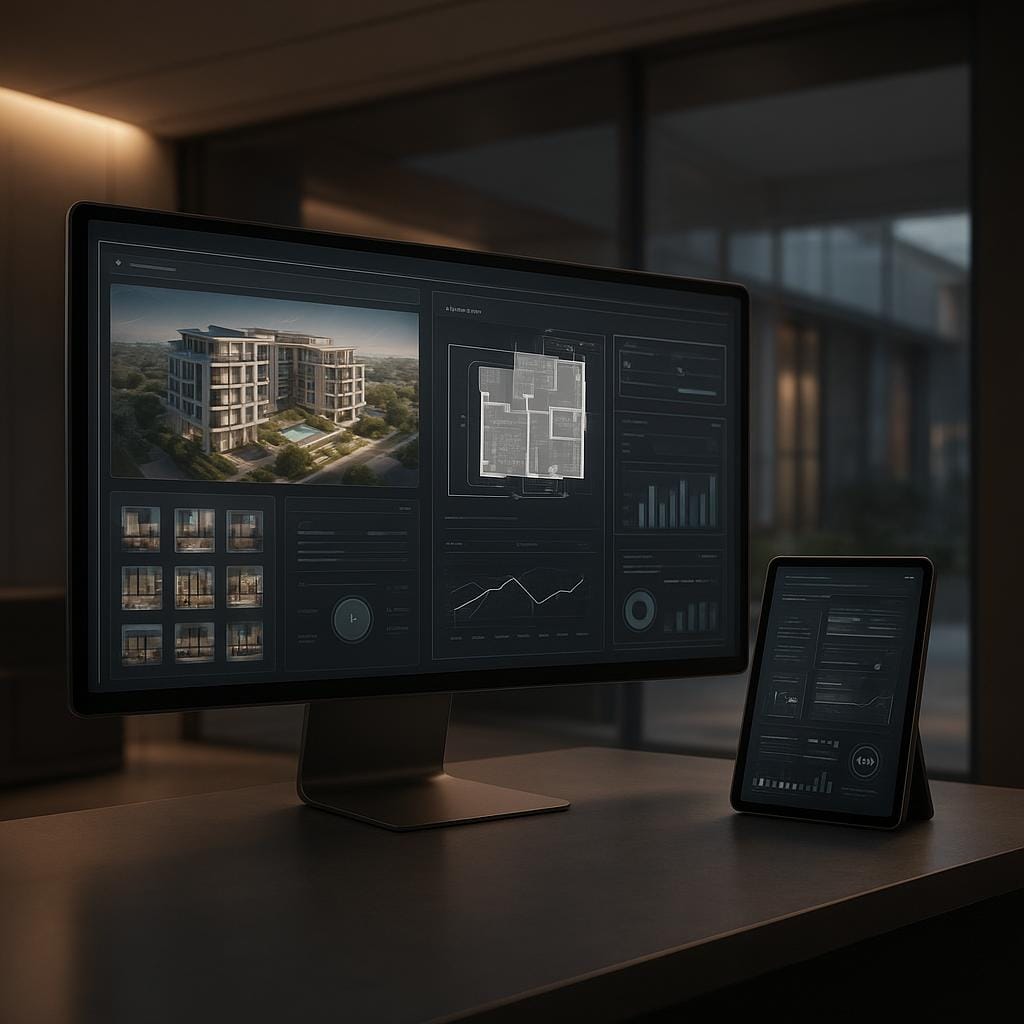

Why 3D web portals are becoming a sales engine for developers
For real estate developers, construction companies, and PropTech investors, the biggest challenge is no longer just building a project. It is selling the vision quickly, clearly, and profitably. That is where 3D web portals create a measurable advantage. Instead of relying on static brochures, scattered PDFs, and long in-person explanations, a portal gives buyers, brokers, and investors an interactive way to explore a project before it is fully built. In a market where speed and trust directly affect revenue, that matters. Research from McKinsey & Company’s growth and sales insights consistently shows that digital buying experiences are now central to B2B decision-making, especially when products are complex and high value.
For developers, the payoff is practical: shorter sales cycles, fewer repetitive site visits, better lead qualification, and stronger conversion rates. For construction firms, a portal also reduces miscommunication by aligning teams and clients around one shared source of truth. For investors, it creates a clearer path to understanding project potential, absorption pace, and revenue visibility.
How 3D web portals solve the real estate sales bottleneck
A modern real estate project often has multiple audiences: end buyers, brokers, corporate tenants, and capital partners. Each of them needs different information at different moments. A well-designed portal centralizes that content and presents it in a guided format. This is not just a visual upgrade. It is a sales infrastructure tool that helps teams manage attention, trust, and action.
With 3D web portals, prospects can navigate masterplans, unit availability, amenities, floor plans, and location context in one place. That reduces friction and improves comprehension. Instead of asking sales teams to explain the same project repeatedly, the portal educates leads 24/7. That means your team spends more time on serious buyers and less time on low-intent inquiries. In many cases, this leads to 20% to 40% better lead efficiency because the portal filters and warms prospects before the first call.
What buyers actually want before they book a meeting
Most buyers do not want more PDFs. They want confidence. They want to know what is available, how the project will look, what the surrounding area offers, and whether the investment makes sense. A portal can present that information through interactive layers, embedded media, and guided navigation. When paired with clear calls to action, it becomes a conversion path rather than a static presentation.
- Immediate clarity: unit mix, pricing logic, and availability are easier to understand.
- Higher trust: buyers see the project in context, which can raise engagement by 30%+ compared with static assets.
- Better lead quality: only serious prospects move forward, improving sales team productivity.
Why AI automation and CRM are the missing half of the equation
Even the best portal will underperform if inquiries are not handled fast. That is why XOR Studio combines 3D web portals with AI automation and CRM workflows. When a lead submits a form, asks a question, or requests a brochure, AI can route, tag, and prioritize the inquiry instantly. The CRM then stores every interaction, so sales teams know who engaged, what they viewed, and when to follow up.
This is critical because response time still drives conversion. Studies frequently cited in sales operations, including insights from Forbes Business Council, show that faster follow-up significantly improves close rates. In property sales, even a delay of a few hours can mean losing a qualified buyer to a competitor. With AI-assisted routing and CRM automation, the first response can happen in minutes, not days.
For internal teams, the operational upside is just as strong. Instead of manually copying lead data between tools, your team gets automated segmentation, reminders, and pipeline visibility. That can reduce admin time by 25% to 50% and make forecasting more reliable.
| Capability | Manual Process | With XOR Studio Technology | Business Impact |
|---|---|---|---|
| Lead response | Hours or days | Instant routing and auto-replies | Higher conversion potential |
| Project presentation | Static brochures | Interactive 3D web portal | Better buyer understanding |
| Sales tracking | Disconnected spreadsheets | Integrated CRM pipeline | Cleaner forecasting |
| Team workload | Heavy manual follow-up | Automated workflows | Lower operating cost |
ROI for developers, builders, and investors
The value of digital transformation in real estate should be measured in revenue, efficiency, and speed to market. A 3D portal supported by AI and CRM can improve all three. Developers gain a stronger pre-sales funnel and better visibility into which units or phases are attracting attention. Construction companies can use the same system to communicate progress, reduce stakeholder confusion, and support handover materials. PropTech investors benefit from a more scalable product that can be reused across assets, geographies, and project types.
According to Statista real estate market data, digital channels are increasingly influencing how buyers research and compare property options. That trend creates a clear opportunity for firms that can offer a premium online experience. A strong portal is not just a marketing asset; it is a revenue asset. It can also reduce the cost of repeated physical presentations, which often consume sales resources without guaranteeing conversion.
For B2B decision-makers, the ROI case is straightforward: more qualified leads, lower manual workload, faster decisions, and stronger pipeline visibility. When those gains compound across a multi-phase development, the financial impact can be substantial.
The best real estate sales systems do not replace people. They give teams better tools to convert interest into revenue faster, with less friction and more data.
How XOR Studio delivers a complete PropTech sales stack
XOR Studio builds technology that matches the realities of property sales. That means designing tools around your sales process, not forcing your team to adapt to generic software. Our approach combines 3D web portals, AI automation, CRM integration, and custom web development into one scalable system. The result is a sales environment that supports marketing, sales, and operations at the same time.
For developers, that can mean a launch-ready portal for a new project. For construction companies, it can mean a client-facing dashboard with progress tracking and documentation. For investors, it can mean a digital product that supports asset presentation and lead generation across multiple portfolios. If you want to see how this works in practice, discover how our XOR Studio PropTech solutions can scale your sales process.
We also recommend reviewing our related resources on how AI chatbots save businesses hundreds of hours and practical AI automation implementation to understand how automation can support your sales team beyond the portal itself.
Final takeaway
In competitive property markets, better visuals alone are not enough. You need a system that helps buyers understand the value, helps sales teams respond faster, and helps leadership track performance with confidence. That is why 3D web portals combined with AI automation and CRM are becoming essential for modern real estate businesses. They do not just improve presentation. They improve ROI, efficiency, and conversion velocity. For developers, builders, and PropTech investors, that is the difference between a project that looks impressive and a project that sells efficiently.
If your team is ready to shorten sales cycles and create a more scalable digital sales process, XOR Studio can help you design the right solution.